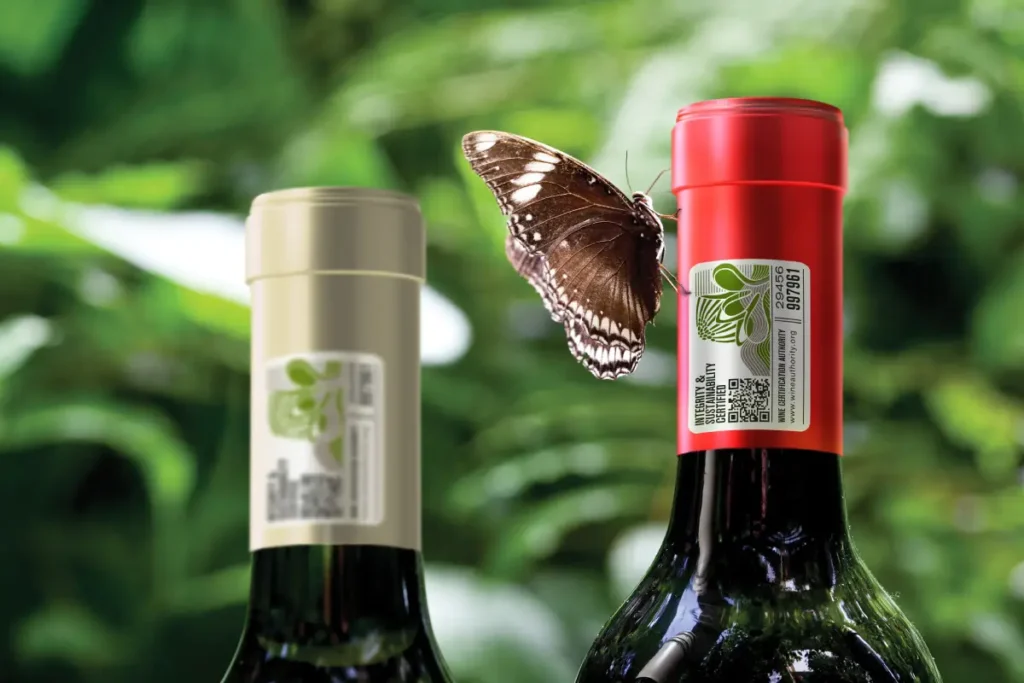
Have you ever noticed a small seal on the neck of a South African wine bottle and wondered what it means? This important certification mark, often playfully called the “bus ticket” by South African winemakers, represents far more than just official paperwork – it’s your guarantee of authentic, sustainable, and traceable wine from South Africa.
What Does the Integrity & Sustainability Certification Mean?
The Integrity & Sustainability seal represents certification by the Wine and Spirit Board (WSB), administered through the Integrated Production of Wine (IPW) scheme that has been operating since 1998, with the 2000 vintage being the first to receive certification. This certification is part of Sustainable Wine South Africa (SWSA), an alliance between the Wine and Spirit Board, the IPW scheme, the Biodiversity & Wine Initiative (BWI), and Wines of South Africa (WOSA).
This comprehensive certification system ensures that every bottle bearing this seal meets strict standards for authenticity, sustainability, and traceability.
The Four Pillars of Certification
1. Verified Vintage, Variety, and Origin Accuracy
The certification guarantees that all information on your wine label is completely accurate:
- Vintage: The year the grapes were harvested to make the wine
- Variety: The grape cultivar used (such as Sauvignon Blanc, Chenin Blanc, Chardonnay for whites, or Shiraz, Pinotage, Cabernet Sauvignon for reds)
- Origin: The specific region where the grapes were grown
For single varietal wines, a minimum of 85% of the stated grape variety must be used, and all grapes must originate from the declared region. This ensures you receive exactly what the label promises.
2. Sustainable, Earth-Friendly Production
The IPW scheme complies with international wine industry environmental sustainability criteria, including the ‘Global Wine Sector Environmental Sustainability Principles’ established by international wine organizations.
South African wine producers certified under this scheme commit to:
- No harmful chemicals: Elimination of herbicides and pesticides in vineyard management
- Hand cultivation: Minimal machinery use with land tilled by hand, vines pruned by hand, and grapes harvested by hand
- Biodiversity protection: The BWI already has 113,000 hectares under conservation status on wine farms, compared to 101,000 hectares of vineyard in South Africa – achieving better than a 1:1 conservation ratio
- Ecosystem restoration: Active restoration of the Cape Floral Kingdom, home to the famous Fynbos vegetation and a UNESCO World Heritage Site
- Job creation: Supporting employment through labor-intensive sustainable farming practices
3. Complete Traceability from Vine to Bottle
Every certified wine bottle features a unique 10-digit reference number that provides complete traceability. By entering this number on the SAWIS (SA Wine Industry Information and Systems) website, consumers can verify:
- All label information accuracy
- Additional details about the wine’s production
- Complete supply chain transparency
- Producer information and certification status
This system protects consumers by providing the same transparency you expect from food ingredients, ensuring you know exactly what’s in your wine and how it was produced.
4. 100% South African Origin Guarantee
The certification confirms that the wine was bottled in South Africa, guaranteeing its authentic South African origin. As one of the world’s major wine-producing countries, this certification proudly represents South African winemaking excellence for both local and international markets.
Annual Quality Assurance
Wine producers participating in the certification program undergo annual audits to ensure consistent standards and regulatory compliance. This ongoing oversight maintains the integrity of the certification system and provides consumers with confidence in every certified bottle.
The Environmental Impact
The South Western Cape, where most South African grapes are produced, represents one of the world’s greatest centers of terrestrial biodiversity. The certification program recognizes this environmental treasure and actively promotes its protection through:
- Sustainable farming practices that protect natural ecosystems
- Biodiversity conservation initiatives that preserve indigenous plant species
- Responsible land management that supports both wine production and environmental stewardship
- Community development through employment opportunities in sustainable agriculture
Why This Certification Matters to Wine Lovers
When you choose a wine bearing the Integrity & Sustainability certification, you’re supporting:
- Authentic South African wine with verified origin and content
- Environmental conservation in one of the world’s most biodiverse regions
- Sustainable farming practices that protect ecosystems for future generations
- Quality assurance through rigorous annual auditing
- Complete transparency with full traceability from vineyard to bottle
- Local communities through job creation and sustainable employment
When you visit the BEN VINO wine festivals, look for the certification seals on our featured wines and ask our knowledgeable staff to share the stories behind these sustainably produced vintages. You’ll discover how South African winemakers are leading the way in combining exceptional wine quality with environmental stewardship.
Discover Sustainable Wine Excellence
Ready to explore South Africa’s certified sustainable wines? Visit the next BEN VINO Wine Festival to learn about our upcoming wine tastings featuring Integrity & Sustainability certified wines. Experience firsthand how South African winemakers are creating exceptional wines while protecting one of the world’s most precious ecosystems.
Join us in celebrating wines that represent the best of South African craftsmanship, environmental responsibility, and authentic quality – all guaranteed by the small but significant seal on every certified bottle.